Applications of Cam Conveyor Chains in Automotive Electronics Assembly Equipment
With the explosive growth of new energy and smart connected vehicles, the assembly processes for automotive electronic modules (such as ECUs, ADAS controllers, and radar sensors) are becoming more complex than ever. A standard automotive electronics assembly line typically involves dozens of sequential processes, including PCB component placement, adhesive dispensing and curing, precision crimping, screw fastening, AOI inspection, and even laser marking. Faced with these lengthy processes and high-precision requirements, traditional turret indexers have long been inadequate—there simply isn’t enough space to accommodate all the workstations. Meanwhile, while traditional pallet-based high-speed lines can be extended indefinitely, they occupy a massive amount of floor space, and their positioning accuracy and response speed often fail to keep pace with today’s demanding high-speed production rhythms. To squeeze out higher production capacity within limited factory space, a number of leading automotive electronics integrators have begun to adopt cam conveyor chains (elliptical/rectangular cam lines) on a large scale.
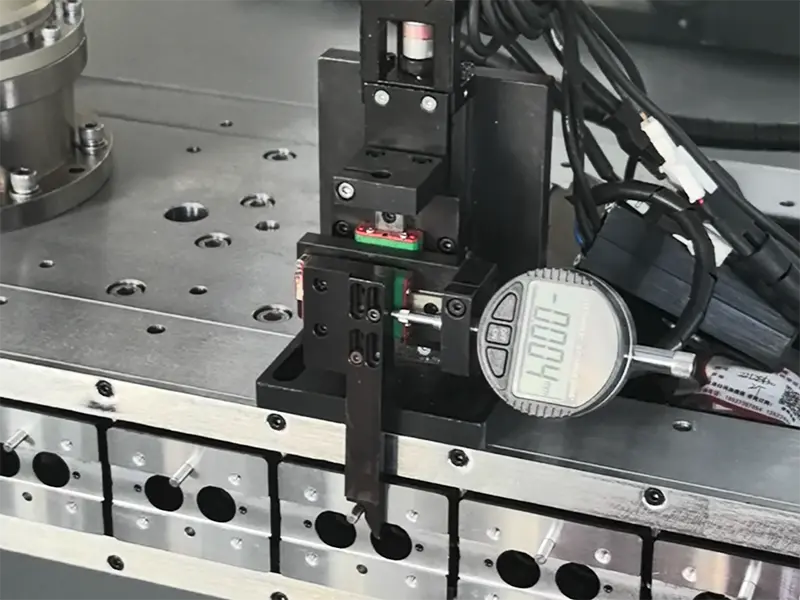
Testing for a Customer's Cam Conveyor Line
1. “Dimensional Efficiency” Through Linear Arrangement, Reshaping Workshop Space Utilization
Automotive electronics assembly lines typically require a large number of specialized automated machines, industrial robots, and test cabinets arranged on both sides. Cam conveyor chains transform the circular motion of traditional turntables into a “straight line,” with workstations compactly arranged along the straight sections on both sides, while the curved ends are used solely for direction changes. This layout perfectly aligns with the narrow, elongated aisles and lean production cell designs of modern factories.
The bulky double-speed chain return lines of the past—which required a large loop and occupied dozens of square meters—have now been condensed into a streamlined, straight-line machine setup. For plant managers, this means that within the same area of a cleanroom or temperature-controlled facility, several additional production lines can be accommodated. This extreme optimization of space utilization represents a complete “dimensional revolution” in traditional equipment layout.
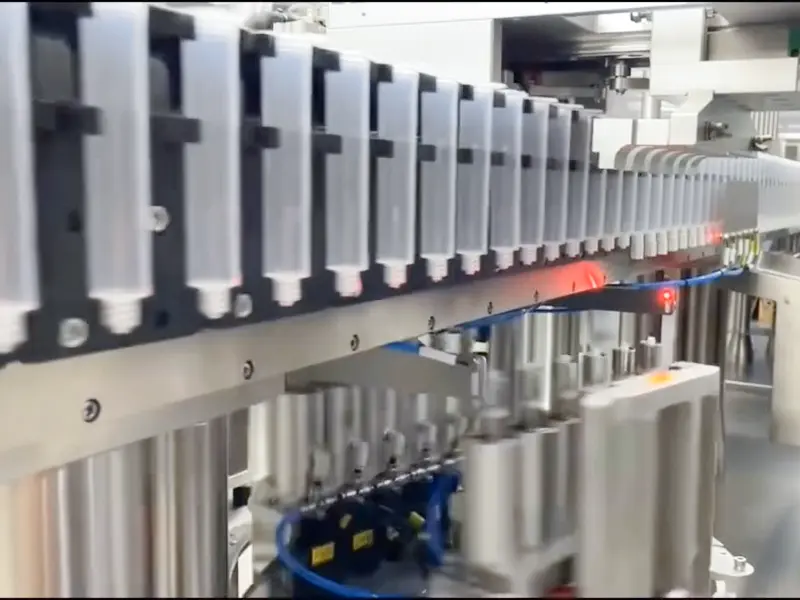
High-Voltage Connector Production
2. Mechanical Self-Locking Ensures Automotive-Grade Precision: The Foundation of “Stability”
The automotive industry has zero tolerance for defects (0 PPM). At critical stations such as ECU pin crimping, precision adhesive application, or ultrasonic welding, even the slightest vibration or rebound in the conveyor line during emergency stops or sudden starts can directly expose an entire batch of products to quality risks or even lead to scrapping.
The cam conveyor chain employs a rigid connection between precision cams and roller bearings. When the conveyor reaches a stop in the linear work zone, it achieves rock-solid repeatable positioning accuracy thanks to high-rigidity guide rails and mechanical self-locking properties. Unlike conventional assembly lines that rely repeatedly on complex secondary pneumatic cylinders for lifting and positioning, this system directly meets the extremely stringent assembly and testing accuracy requirements of automotive-grade products through its fundamental mechanical stability.
3. Say Goodbye to Heavy Drag—Achieve High Returns Through “Energy Efficiency”
Traditional asynchronous pallet return lines are lined with heavy metal pallets. The drive system must not only overcome enormous friction but also maintain high-power operation around the clock, resulting in extremely high energy consumption.
Through ingenious physical structural optimization, the cam-driven conveyor chain evenly distributes weight across precision guide rails, significantly reducing the overall inertia of moving parts. At the same high cycle rate, it requires a servo motor with lower power output and operates much more smoothly. The significant energy savings resulting from this design can generate substantial daily electricity cost savings for the factory during the 24/7, three-shift production of automotive electronic components.
4. Minimalist Design and Modularity: Unparalleled “Ease of Maintenance”
Under the intense pressure of tight delivery deadlines from automakers, Tier 1 suppliers of automotive electronics fear equipment downtime above all else. With traditional large indexing tables or custom-built machines, if a core component fails, repairs often require complete disassembly, bringing the production line to a complete halt.
In contrast, the cam conveyor chain not only exhibits extremely low wear but also incorporates a highly modular design philosophy. Components such as chain links, sliders, and positioning pins can all be quickly disassembled and reassembled individually. Combined with preventive maintenance alerts from the digital control system and an automatic centralized lubrication system, routine maintenance requires virtually no production line shutdowns for major repairs. This outstanding ease of maintenance ensures that the production line’s OEE (Overall Equipment Effectiveness) remains consistently high, truly providing peace of mind for technical supervisors.
The transition from bulky traditional production lines to compact, high-speed, high-precision cam-driven conveyor chains is not merely a change in transmission methods; it is also an inevitable result of the evolution of automotive electronics equipment toward digitalization and flexibility. For technical supervisors, it makes complex process integration a breeze; for integrators, it serves as the core hardware asset for securing high-end automotive electronics automation projects; and for factory owners, selecting advanced equipment with high floor space efficiency, low energy consumption, and maintenance-free operation lays the most solid foundation for profitability amid fierce competition in an era of slim margins.