What tests are typically required for cam-driven conveyor chains before shipment?
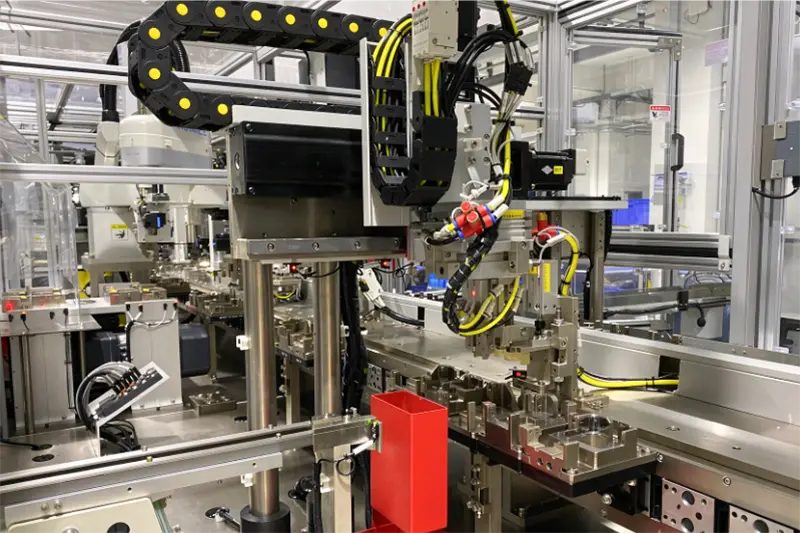
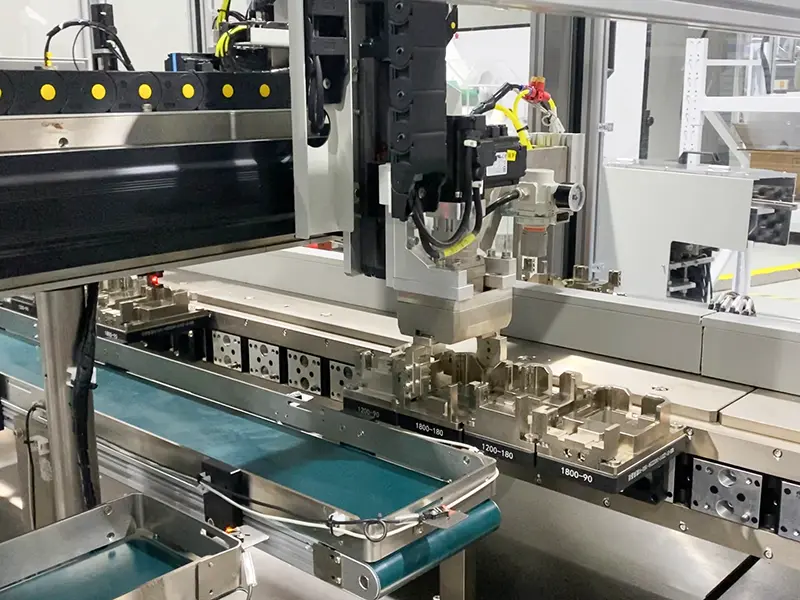
For automated production lines, any failure of core drive components on-site can result in a catastrophic shutdown of the entire line. The reason cam conveyor chains are able to outperform traditional equipment is not only due to the advantages of their linear physical structure, but also because of the extremely rigorous performance verification they undergo before leaving the factory. To ensure this system delivers ultimate stability and ease of maintenance in cleanrooms and automotive electronics assembly lines, every qualified cam conveyor chain must undergo the following core factory inspections before shipment:
1. Pre-stretching and Pin Ejection Force Testing
Conventional chains inevitably stretch and become loose during the initial period of use, leading to positioning deviations. To completely resolve this issue, high-quality cam conveyor chains must undergo pre-stretching testing after assembly. Typically, a tensile force equivalent to one-third of the chain’s ultimate breaking load is applied during the break-in process. This effectively exhausts the chain’s “initial deformation” in advance, ensuring an extremely tight fit between the inner links, sleeves, and rollers, thereby extending its service life. Concurrently, a pin ejection force test is conducted to ensure a sufficiently secure interference fit between the outer links and the pins. This test directly ensures that the equipment will never experience basic failures such as link disengagement or chain breakage under high-speed, heavy-load conditions.
2. Static Precision Calibration and Pitch Inspection
The core selling point of cam-driven conveyor chains is their “precision that rivals or even surpasses that of disc indexers.” Before shipment, quality control personnel must use high-precision measuring instruments to rigorously measure the pitch of each chain link, ensuring that the cumulative dimensional tolerances after assembly are controlled within standard limits and preventing pitch errors from causing poor sprocket meshing or abnormal operating noises. Next comes the repeatability test, which simulates positioning during workstation pauses. Leveraging the mechanical self-locking properties of precision cams, the test measures the microscopic displacement of the slider when it locks onto the straight section of the guide rail. Only by ensuring that the positioning accuracy of every emergency stop is rock-solid can subsequent processes—such as ultrasonic welding and precision crimping—be carried out without any deviation.
3. High-Speed Run-In and Temperature Rise/Vibration Testing
Static accuracy isn’t true accuracy; true capability lies in stable operation under load. Before shipment, finished products are mounted as a complete unit on a test bench to undergo continuous no-load and simulated full-load running-in tests. On one hand, high-speed operation is used to detect system noise and vibration amplitude. If the meshing surfaces of the cam and driven components are not machined properly, abnormal noises will occur at high speeds; on the other hand, this is also an extreme test of the internal lubrication and thermal balance within the core cam housing. If the guide rails lack lubrication, the mechanism will suffer irreversible damage; if there is too much oil or excessive friction, the oil temperature will rise abnormally. Excellent running-in performance not only indicates extremely low mechanical wear but also serves as the physical foundation for the device’s significant energy-saving advantages.
4. Torque Limit and Rigidity Verification
At assembly stations for automotive electronics or medical devices, fixtures often need to withstand extreme downward pressure, riveting forces, or lateral loads. Therefore, pre-shipment testing must include both static and dynamic rigidity verification. The testing equipment applies simulated impact forces from various directions to the slide block positioned in the linear work area to verify the torque resistance of the cam self-locking mechanism and the load-bearing limit of the guide rails. This test ensures that the conveyor chain will not yield even slightly under stress during high-tonnage mechanical operations on the production line, truly remaining “immovable” even under high pressure.
5. Sealing, Dust Protection, and Grease Leakage Inspection
For industries with extremely high cleanliness requirements, such as medical consumables or precision electronics, the maintainability of equipment is reflected not only in ease of repair but also in its ability to “avoid causing additional problems.” Before shipment, rigorous inspections must be conducted on the chain’s sealing structure, housing oil seals, and self-lubricating components. It is essential to ensure that, even during continuous high-speed operation, the internal lubricant remains at the standard level and absolutely does not leak into the cleanroom area, while simultaneously preventing external dust from entering the track interior. This fundamentally eliminates secondary contamination caused by oil residue and prevents batch scrapping.