Applications of Cam-Driven Conveyor Chains in the Medical Industry
Traditional automated production lines—especially those using large-disc cam indexers—are extremely cumbersome when faced with medical assembly processes that often involve two or three dozen complex workstations. The massive discs not only take up valuable cleanroom space, but once the workstations are fully occupied, there is no room left for future upgrades or modifications. How can one ensure an extremely high yield rate while significantly increasing production capacity in such a demanding environment where “every inch of space is at a premium”? Today, an increasing number of cutting-edge medical automation integrators have provided a solution with significant commercial impact: the introduction of cam conveyor chains (elliptical/rectangular cam lines).
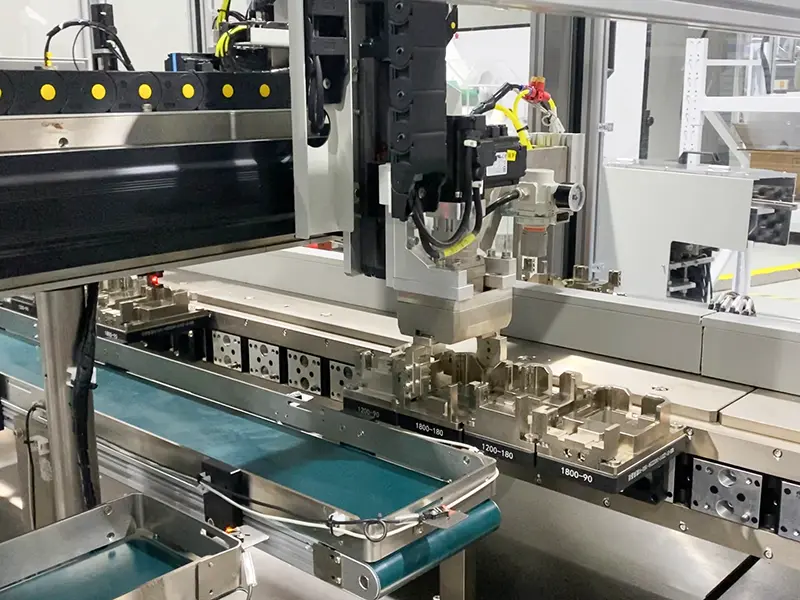
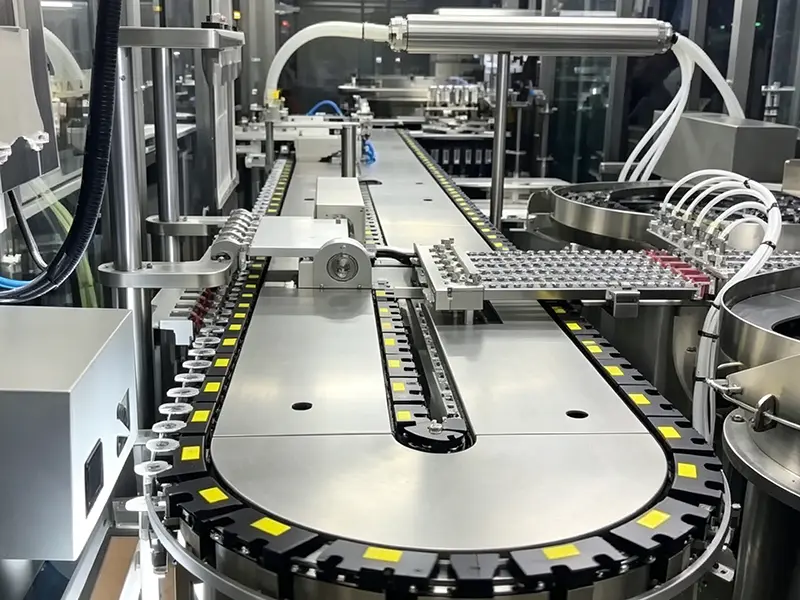
BC80-8T used in Medical Syringe industry
Why is there an urgent need for cam conveyor chains in medical assembly?
Automation in the medical industry has a much higher barrier to entry than in general 3C or hardware sectors. It imposes nearly exacting requirements for cleanliness, consistency, and traceability. Cam conveyor chains perfectly address these core requirements:
1. Breaking Free from Spatial Constraints to Achieve a “Dimensional Breakthrough” in Space Efficiency
In medical cleanrooms, the more compact the equipment can be, the greater the profit margin. Cam conveyor chains “straighten out” traditional circular tracks, concentrating all workstations along the straight sections on either side. This means that equipment that previously required a large square footprint can now be designed in a narrow, elongated shape, perfectly aligning with the layout of the workshop’s aisles and columns. A workshop that could previously accommodate only two production lines can now easily fit four. Expanding the number of workstations from a dozen to several dozen poses no challenge. This extreme optimization of space utilization directly doubles the factory’s “floor efficiency.”
Applications of Cam-Driven Conveyor Chains in Medical Test Kits
2. Rock-Solid Mechanical Self-Locking Ensures Medical-Grade Precision
The assembly of medical products often involves micro-level liquid dispensing, precise needle crimping, and even micron-level ultrasonic welding. When a high-speed production line stops, even the slightest vibration can result in a batch of defective products.
The cam conveyor chain inherits the mechanical precision of precision cams. When the chain links come to a stop in the linear work zone, they rely on high-rigidity guide rails and the mechanical self-locking mechanism of the cam structure to achieve extremely precise positioning without the slightest hesitation. This fundamental physical stability ensures that the assembly precision of every test kit and every blood collection tube remains consistent, allowing technical supervisors to finally put an end to the nightmare of “yield rates dropping as soon as equipment speeds up.”
3. Designed for Cleanrooms: Minimalist Design and Easy Maintenance
Under the GMP system, medical production lines fear two things most: first, dust contamination of products; second, unplanned downtime.
Traditional complex chain mechanisms are prone to generating debris through friction, whereas high-quality cam conveyor chains feature fully enclosed or low-lubrication precision roller designs that significantly reduce metal friction and grease evaporation, naturally meeting the requirements of high-grade cleanrooms.
More importantly, they are easy to maintain. Medical orders often have tight deadlines, and a single day of equipment downtime results in significant losses. The modular design of cam conveyor chains allows for quick, localized replacement of guide rails, sliders, and fixtures. Unlike the “major operation” required to repair large discs, frontline maintenance personnel can handle this quickly, greatly boosting the equipment’s OEE (Overall Equipment Effectiveness).
4. Say Goodbye to “Overkill”—Outperform the Cycle with Energy Efficiency
Medical consumables are characterized by high-volume, continuous production, with production lines often operating 24 hours a day without interruption. Driving a heavy, solid disk loaded with fixtures consumes a significant amount of electrical energy with every start and stop; in contrast, the cam conveyor chain drives only the sliders and chain on the track, reducing motion inertia exponentially.
At the same cycle time, the motor experiences a lighter load and operates more smoothly. This structural energy-saving advantage will save enterprises a considerable amount in hidden electricity costs during day-to-day mass production, truly aligning with the current survival principle in manufacturing of reducing costs and improving efficiency. Shenzhen BZBCBK Intelligent Equipment Co., Ltd. specializes in cam-driven circular conveying technology. The company primarily offers cam conveyor chain systems and high-precision U-shaped guide rail rotary drive units, with repeatable positioning accuracy at the micrometer level. These systems support synchronized continuous operation across multiple stations and can be customized to meet non-standard requirements. They are widely used in automated production lines for new energy, optical communications, PCBs, medical devices, automotive electronics, and daily chemical product filling.